
What is New in Microsoft CRM for 2026
Join us to explore Microsoft Dynamics 365 Sales in 2026, where Copilot-powered, role-based Sales Agents and Sales Chat reshape prospecting, qualification, and deal execution. We’ll show how AI automates SDR tasks, surfaces real-time insights in Outlook and Teams, strengthens forecasting and pipeline hygiene, and connects seamlessly to your data—so sellers spend less time on busywork and more time closing.
Agenda
· What’s New in 2026: Copilot Sales Agent, Sales Chat, and in-flow assistance in Outlook/Teams
· Prospecting & Qualification: Autonomous lead research, scoring, and automated follow-ups
· Opportunity Management: AI summaries, next-best actions, and meeting prep/recap
· Forecasting & Pipeline Health: Enhanced AI forecasting, data cleanup, and coaching signals
· Collaboration in the Flow of Work: Email drafting, call insights, and Teams meeting intelligence
· Admin & Governance: Analytics dashboards, controls, and security for Copilot/agents
· Roadmap & Adoption Tips: Rollout patterns, training, and quick wins for sales leaders


Microsoft CRM (Sales, Marketing, and Service)
The potential increase in sales by using Microsoft CRM software can be significant, with companies that use CRM effectively seeing their conversion rates triple. This improvement in communication processes and maximizing sales efforts can lead to a 30% increase in sales for some businesses. Additionally, CRM can enhance customer satisfaction and retention rates, and improve upselling and cross-selling success.
Agenda:
1. Sell more with CRM for sales (5 key screens), the 5 screens that your reps will use daily including Sales Copilot!
2. The 3 key CRM tools of 2025 that are included at no charge (Sales Copilot, Power BI for reporting, integrated calling).
3. Sales manager tools & reporting, it is all about the numbers!
4. Customer service made easy!

Best Microsoft Software & Tools for 2023
Microsoft’s Dynamics 365 CRM and ERP platform continues to evolve with new features and capabilities. In 2023, we can expect to see further integration with other Microsoft products such as Teams and Power Platform, as well as new capabilities such as AI and machine learning. This webinar will focus on software and tools that a typically Canadian Manufacturer or Distributor will require for 2023 and beyond.
Agenda
1. Security and Infrastructure
2. ChatGPT and Project Cortex
3. Sales, Marketing and Service
4. Accounting
5. Manufacturing and Distribution
6. Microsoft 365
7. Power Platform
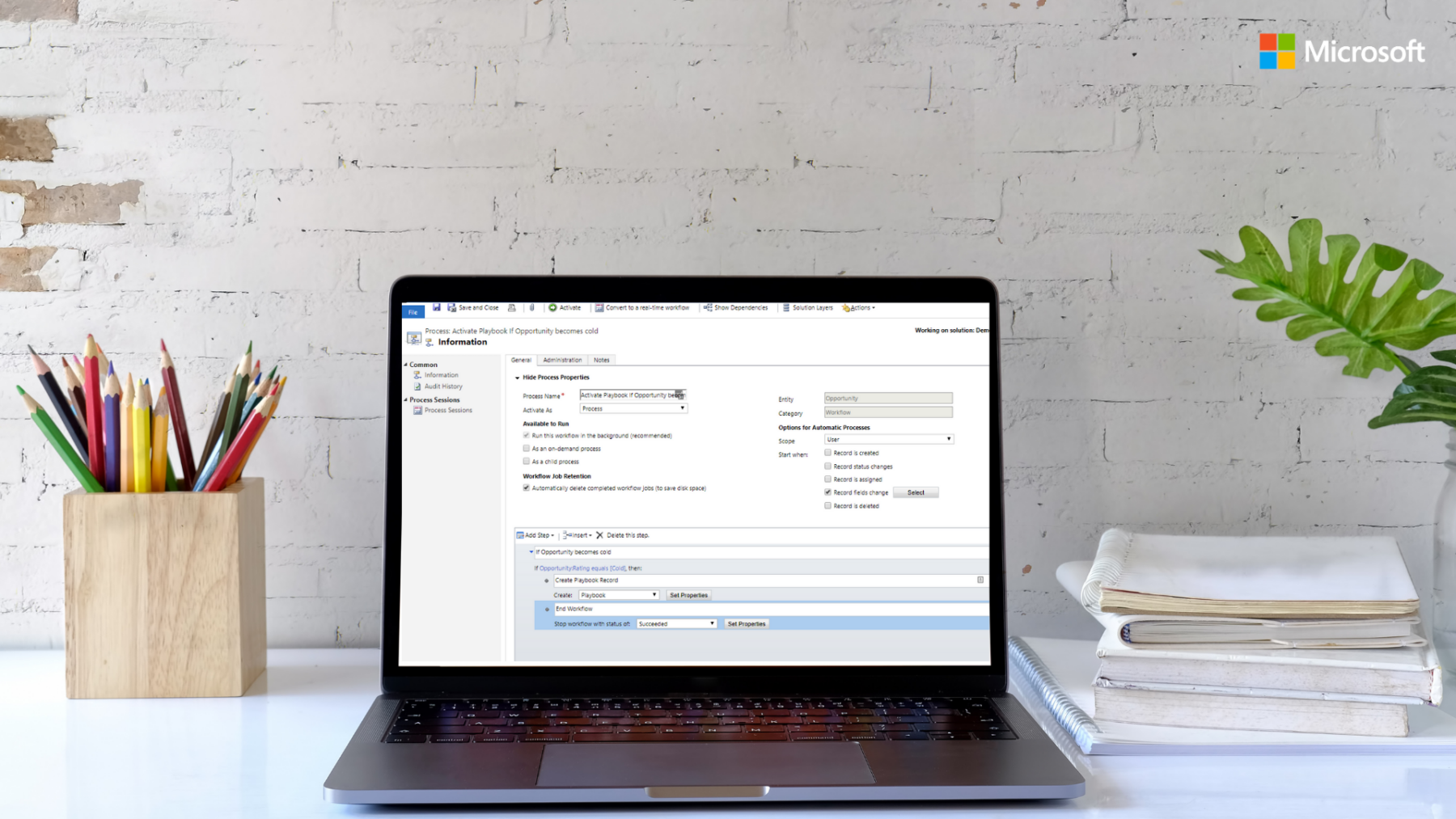
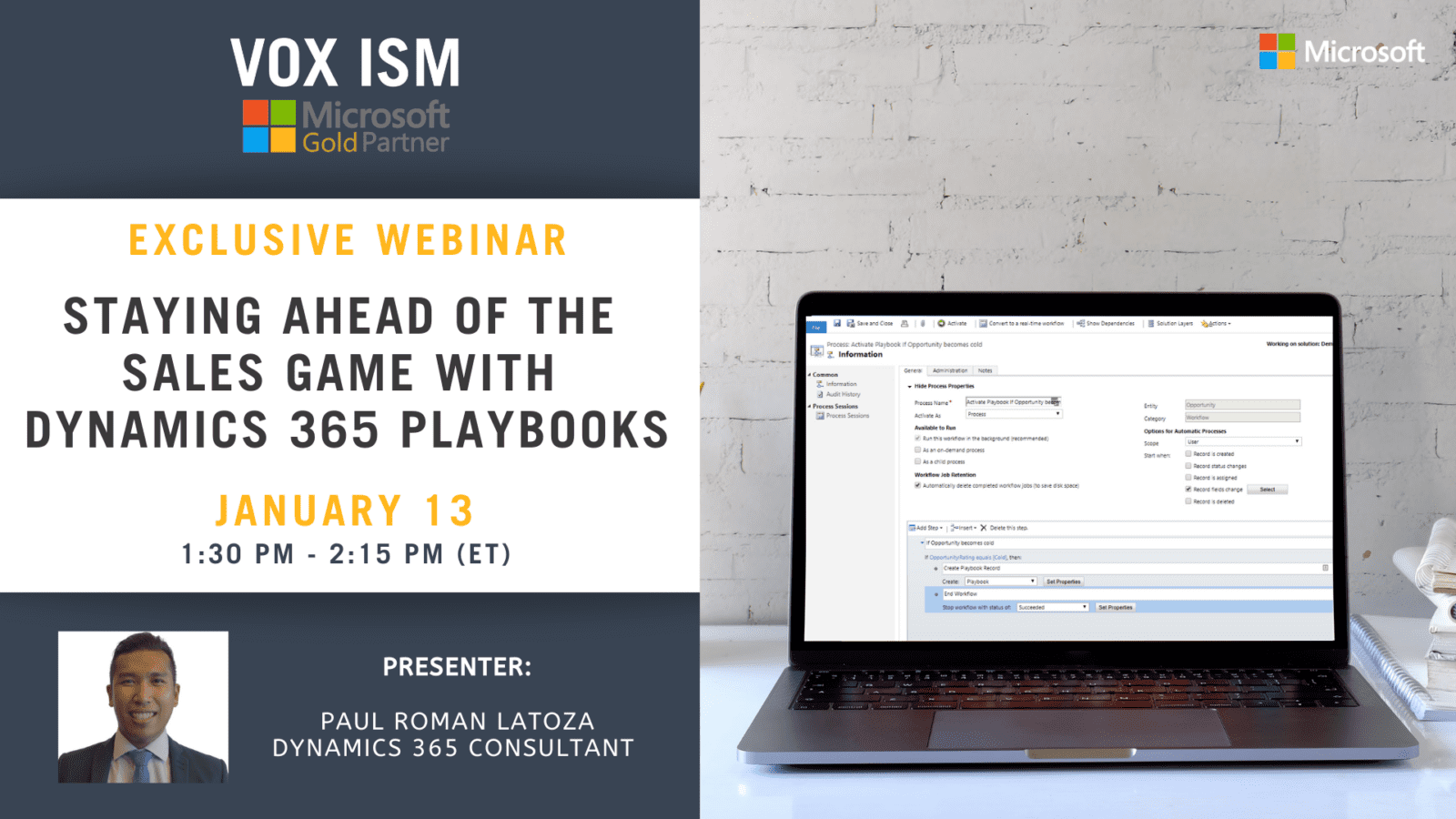
Staying ahead of the Sales Game with Dynamics 365 CRM Playbooks
Does your Sales Team struggle with scheduling the next best actions with regards to a lead or an opportunity? A couple of examples would be if a new lead is generated on the website and scheduling standard set of activities such as a phone call and an appointment, or if implementing best strategies when a key decision-maker departs while pursuing a large opportunity or if when a top-tier customer requests a discount on a quote? Well, look no further because Dynamics 365 CRM Playbooks are here to help!
The Dynamics 365 CRM Playbooks tool for Sales is designed to enforce a series of defined activities that should be triggered in the event of a specific scenario, or within the context of a process – guiding team members along the way and responding more effectively to common sales scenarios as mentioned earlier.
If you are interested, check out this quick intro demo from Microsoft here: https://youtu.be/_N88QLIom10.
The full product documentation can be viewed here as well: https://docs.microsoft.com/en-us/dynamics365/sales-enterprise/enforce-best-practices-playbooks.
Getting started!
To start, you will need to make sure that the Playbook solution is installed into your current Sales Hub App. You also need to make sure that entities such as Playbook categories and Playbook templates are published on the site map as well. Then, a team member with a Playbook manager role or equivalent permissions creates playbook categories to classify the playbooks.
The playbook manager creates playbook templates that define a set of best practices based on past experiences and their organization’s standards. A business user such as a salesperson or service rep who has been assigned a Playbook user role can then open one of these playbook templates while they work on their records. The playbook template helps ensure that best practices are applied consistently at every step.
Launch a Dynamics 365 CRM Playbooks to carry out activities consistently
To ensure consistency in your business process or to know what steps to follow in certain scenarios or events, rely on the playbooks prepared by your managers that guide you with the actions you can take. Dynamics 365 CRM Playbooks can also contain best practices based on practices that have worked in similar situations before.
- Make sure you have the Playbook user role or equivalent permissions.
- Go to the record you want to launch the playbook from. For example, if you know your organization has playbooks created for opportunities, open an opportunity record.
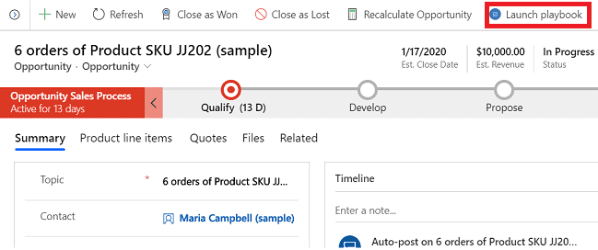
- On the command bar, select Launch playbook.
- In the Playbook templates dialog box, select a playbook that you want to use and then select Launch.
You’ll see a notification “Playbook launched successfully.”
Mark a playbook as completed
When you complete all the activities created for a playbook, you must mark the playbook as completed. This helps you to know if the playbook was successful or not.
- To mark a playbook as completed, go to the record you launched the playbook from (calling record).
- Select the Related tab, and then select Playbooks.
- Open the playbook record.
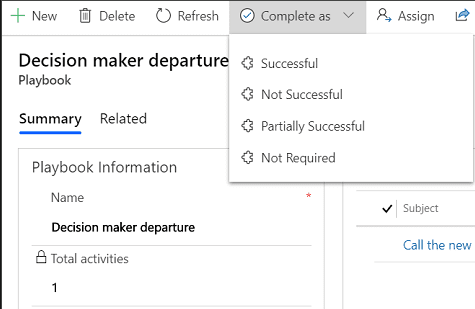
- In the playbook record, on the command bar, select Complete as, and then select one of the following results:
-
- Successful
- Not Successful
- Partially Successful
- Not Required
Track playbook activities
When a playbook is launched, its related activities are created and associated with the record the playbook is launched from (also called the calling record). You must complete these activities to ensure every event is dealt with consistently.
If the playbook template used for the playbook has its Track progress field set to Yes, the activities are created under a playbook record that is under the calling record. If the Track progress field is set to No, the activities are created directly under the calling record.
To see the activities created by the playbook when the Track progress field in the playbook template is set to Yes:
- Go to the record you launched the playbook from. For example, if you launched the playbook from an opportunity record, go to the opportunity record.
- Select the Related tab, and then select Playbooks.
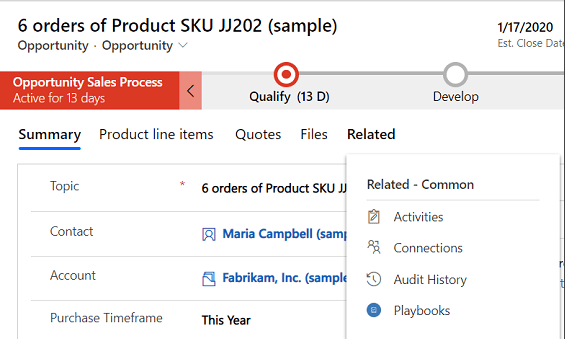
3. In Playbook Associated View, the playbook launched from the record is listed.
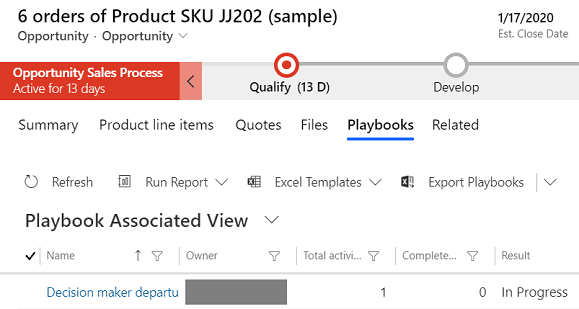
4. Select the playbook. The playbook record shows all the details about the playbook and its associated activities.
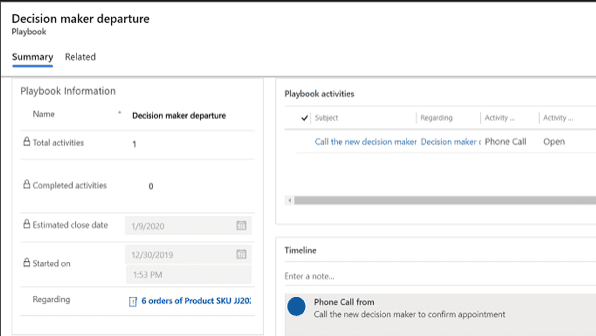
For example, it shows when the playbook was launched, how many total activities it has, how many of the activities are completed, and the estimated close date. It also shows all the related playbook activities in the Playbook activities section. After you are done working on these activities, mark them as completed.
To see the activities if the Track progress field of the playbook template is set to No, in the calling record, see the Timeline section.
Alternately, in the calling record, select the Related tab, and then select Activities.
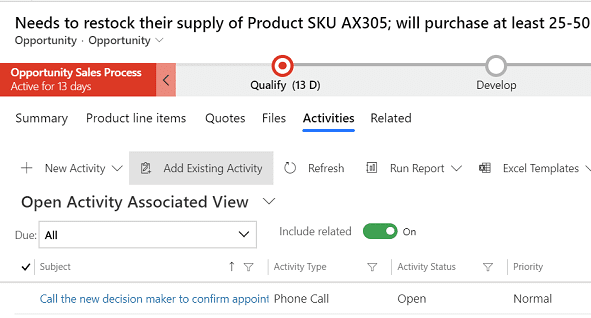
The Open Activity Associated View lists all the activities for the calling record along with the playbook activities created since the playbook was launched. However, this view doesn’t show the total number of activities that have been created in the context of a playbook.
Conclusion
Now that you have read how Dynamics 365 CRM Sales Playbooks can be for you and your Sales Team – come check out our next CRM webinar coming this Wednesday, January 13, 2021, where we will see Dynamics 365 CRM Sales Playbook LIVE in action!


The hardest part of implementing a new CRM at your offices: Start with the rocks
If you’re implementing a new CRM and you chat with me you’ll quickly realize that I’m quite excitable when I start talking about Microsoft Dynamics 365 and the Office 365 tools and features. As such I tend to get my customers just as excited. That’s when the problems start. I’ll rave about how you can receive word documents in Outlook, edit them and send them right back to contacts without having to download it on your computer first. And how all of these emails are easily tracked in Dynamics 365 thanks to Outlook integration. Then I’ll go on raving about reviewing sales rep activities without their manager having to bug them every Friday to fill out their excel template. Reps hate filling them out by the way, they just want to sell. What about marketing, you ask? Generated leads can be handed off to sales with a seamless and fully automated process in CRM.
So how does getting excited about new features lead to problems? And what does this have to do with rocks?
The story of priorities can be represented by using a jar filled with rocks, pebbles and sand. Each item representing how to obtain a meaningful life. It turns out we can use this same analogy to represent implementing a CRM solution. If you add the critical items (the rocks) first to your CRM system, you will own a functional system. Then you can add the other items that matter (pebbles), and finally add the small items (sand). IMPORTANT – If you add them out of sequence or all at once will result in a failed implementation. The best solution is to take a deep-breath and roll out a step-by-step plan to get the ‘rocks’ in the CRM system first, followed by ‘pebbles’, then finally add the ‘sand’.
With support and feedback from our own sales and marketing teams, as well as our D365 Consultants and from our customers, we have come up with a sales and marketing starter kit. Here’s what you need:
- Your core screens configured for ease-of-use (Accounts, Contacts, Opportunities, Activities, Dashboards)
- Mobility features deployed: App for Outlook, Dynamics 365 for Phones, Unified Client Interface (Hubs!)
- Sales management tools for forecasting, sales performance, and activity management
- A marketing to sales handoff workflow
- Marketing management tools to manage KPI and drive lead generation
Start with the basics (rocks) and let your CRM system grow at your pace and as you grow. Microsoft Dynamics 365 is constantly expanding its features, improving integrations and adding in new tools. When implementing a new CRM solution develop a starter plan with your critical items addressed first. Then work towards your long-term goals and execute these in one step increments. When user adoption is showing promise, and only then, start to add more modules (pebbles and sand).
Start with the rocks.
Join us on September 5 at Microsoft Canada HQ in Mississauga to see Microsoft Dynamics 365 CRM in action!

Blog post by Jacob Steinfeld – Dynamics 365 Solution Architect

Jacob Steinfeld is a graduate of the Electronic Media Design program at Langara College in Vancouver, British Columbia, specializing in marketing & user interface design. For the last 3 years, Jacob has been a Dynamics 365 consultant with VOX ISM, supporting our various customers in the manufacturing, distribution, and healthcare industries. Jacob brings his sales and marketing expertise to his customers to aid in the implementation of new CRM systems.

Dynamics 365 Customer Engagement Tips and Tricks from an Expert
As a Dynamics 365 Trainer and Architect for the past 3 years, I have learned one unfortunate truth, not enough users explore the system. Instead, we get stuck in the ruts of ‘SOP says to do A this way, B this way, and C that way’ and we never deviate. Probably because that’s what the boss says and I don’t have the time to figure new things out. Well, every once in awhile, you should. Start by carving out 30 minutes on a slow Friday as your internal training time. Or carve out 30 minutes on an occasional Wednesday and attend a free VOX ISM event. For example, on Wednesday, July 24th, I’ll be showcasing some of those extra features that don’t always fit into your SOP that will make your CE experience more enjoyable.
I’ll start by highlighting some of the absolute basics.
1. Use ctrl + left mouse click to open records in new tabs or windows. When you’ve set up that perfect view of filtered data, and you click on a record and navigate away when you hit that back button your filters have reset. Get in the habit of ctrl-clicking to open up your info in a new window or tab, then simply close it to pick up where you left off. I tell my sales reps working on Opportunities that if you want to know everything about an account while you’re on the call, just ctrl-click the account record from your phone call window.
2. Ditch the long navigation and go directly to your record with the Search tool. When I ask my customers to open specific accounts they always go; Navigation menu, the arrow next to Sales, then from the expanded menu they click on Accounts, then they scroll through the view, change the view, or use the search window on the right side. Skip the middle man, just use the Search on your main navigation. It’s always there, and it’s your best friend.
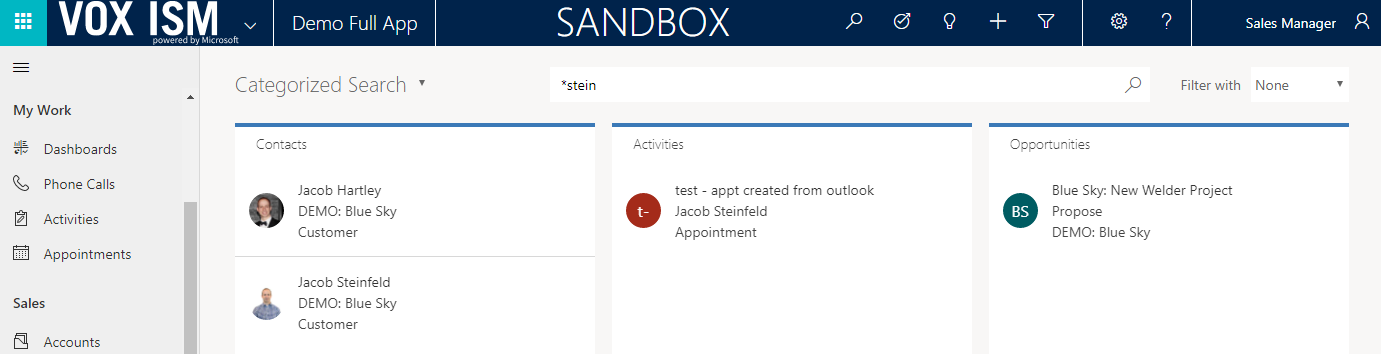
3. Double search tip, use the * (shift+8) to perform a wildcard search. Can’t remember the name of an account but you know it’s something “international”. Then search “*international”. The * breaks the string and looks for anything with the word international. Triple search tip! You don’t need even fully to spell international, “*inter” will suffice. This is especially helpful for those of you looking for Jacob Steinfield instead of Jacob Steinfeld, you could just search “*stein”, and you’d find me. Wait, why am I in your CRM?
4. Regular Outlook is boring. Stop having a boring Outlook, stop having a boring life. Learn the D365 App for Outlook. You can track communications, quickly convert Outlook contacts to CE Contacts, create Opportunities, schedule phone calls, send dynamic email templates… The list goes on. If I spent a day with you training Sales in Dynamics 365 CE from the browser, everything I show you on that day you could do from Outlook too with the D365 App for Outlook.
For those of you not using these four tips, start. For those of you already using these four tips and are looking for the next level tips, come to our event. We’ll show you the new LinkedIn connection right into Outlook, using workflows to make the system do your job for you (it can’t sell for you per se, but we’re close), creating dynamic reports from anywhere, and more.
Check VOX ISM’s event page for weekly free events. We have 67 events in the second half of 2019, and I’ll be presenting CE on several of them.
Jacob Steinfeld – Dynamics 365 Solution Architect
Jacob Steinfeld is a graduate of the Electronic Media Design program at Langara College in Vancouver, British Columbia, specializing in marketing & user interface design. For the last 3 years, Jacob has been a Dynamics 365 consultant with VOX ISM, supporting our various customers in the manufacturing, distribution, and healthcare industries. Jacob brings his sales and marketing expertise to his customers to aid in the implementation of new CRM systems.

Microsoft Dynamics 365 CRM 101 – “Making a Phone Call”
A phone call is the backbone to any sales reps’ healthy pipeline. This seemingly simple activity generates valuable insight and can move the prospect through the sales cycle much faster than emails & text messages alone. So how does a Sales Rep make a successful phone call? What are the steps and how can the rep be the most effective? With the help of Microsoft Dynamics 365 CRM!
- Decide on who you are going to call? What products/event would this prospect be interested in?
- Create the Marketing List – List of the prospects to be targeted.
- The System creates the Phone Call Activity in CRM with the appropriate Due Date
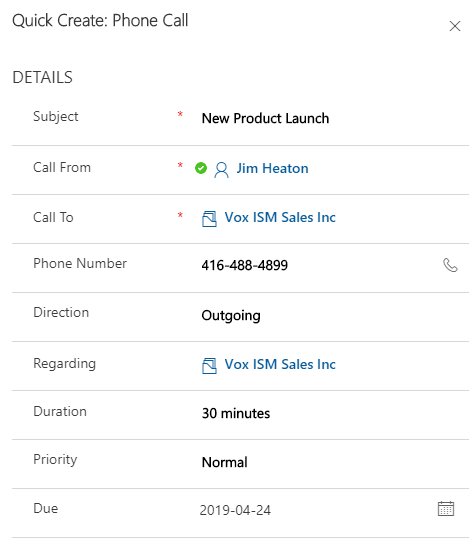
Once the phone call activities have been created, you are now readily capable to complete 60 phone calls daily, of which 1 of 7 will be picked up (answered). By having these phone call activities created, it is easy to stay on top of prospects. Not only does Microsoft Dynamics365 CRM allow for you to keep on top of your prospect communications, but Automated Workflows make this entire process even easier; with the click of a button (Left Voicemail) the phone call is automatically re-scheduled for the sales rep. and an email is sent out.
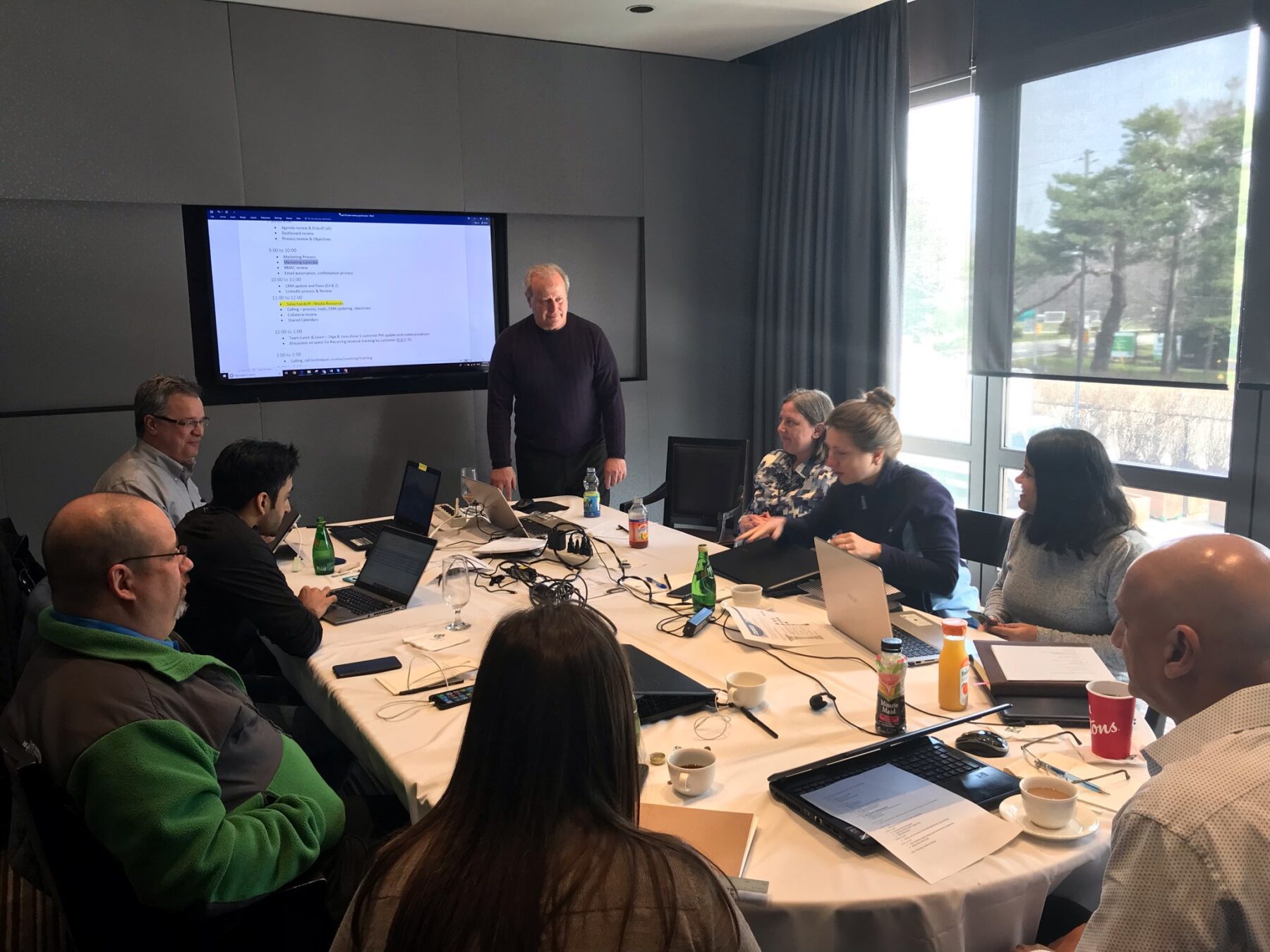
Interested to learn more about Microsoft Dynamics 365 CRM?
If you would like to see Microsoft Dynamics 365 CRM in action, please attend BMAC 2019. BMAC – Best Manufacturing Apps Conference. The BMAC is a one-stop experience that brings together Canadian manufacturers and industry experts and keeps them ahead of manufacturing’s digital transformation. The Best Manufacturing Apps Conference 2019 will be held on May 16, at Microsoft Canada HQ, Mississauga from 1:30 PM – 3:00 PM.

Lessons Learned from Moving to the Cloud - Dynamics 365 for Sales
What happens when you turn on all of Microsoft’s features for Dynamics 365 for Sales
Spoiler alert: If you’re turning on features that even Microsoft hasn’t fully vetted your computer will not explode; but, if you were looking for an excuse to pour your coffee onto your machine and call it a day, you’ll find one. The good news is, it is completely worth it.
Keep reading.
At Vox ISM, on March 4 2019, we will be fully live on Dynamics 365 for Sales, Service, and Project Service. We will also be live in the Cloud on Business Central and Power BI. We’re making the migration from CRM 2015 on-premise and NAV 2015 on premise. Being the eager person that I am, in January when this project started, I insisted we turn on every feature and tool available for these apps. What was I thinking? I have just shy of 3 months to turn on everything and I can be quoted as saying, “we have to, it’s awesome!” 40 users, a full suite of products, 4 departments going live, all happening on March 4. We enabled:
- LinkedIn Account and Contact integration
- LinkedIn Campaigns integration
- Business Central two-way integration with Sales
- BC and Sales Order integration
- BC and Sales Product integration
- BC and Sales Account integration
- Power BI integration in both systems (ERP and CRM)
- Organization Insights
- Dynamics 365 App for Outlook
- Relationship Assistant (AI)
- Email engagement (AI)
- Hubs <- and according to Microsoft we’re the 1st ones to do so.
- Mobile device deployment
- OneDrive integration
- OneNote integration
- SharePoint integration
- Microsoft Teams
- We moved the entire company to Office 365 and Microsoft Exchange Online.
- Portals
And probably a few others that are eluding me right now.
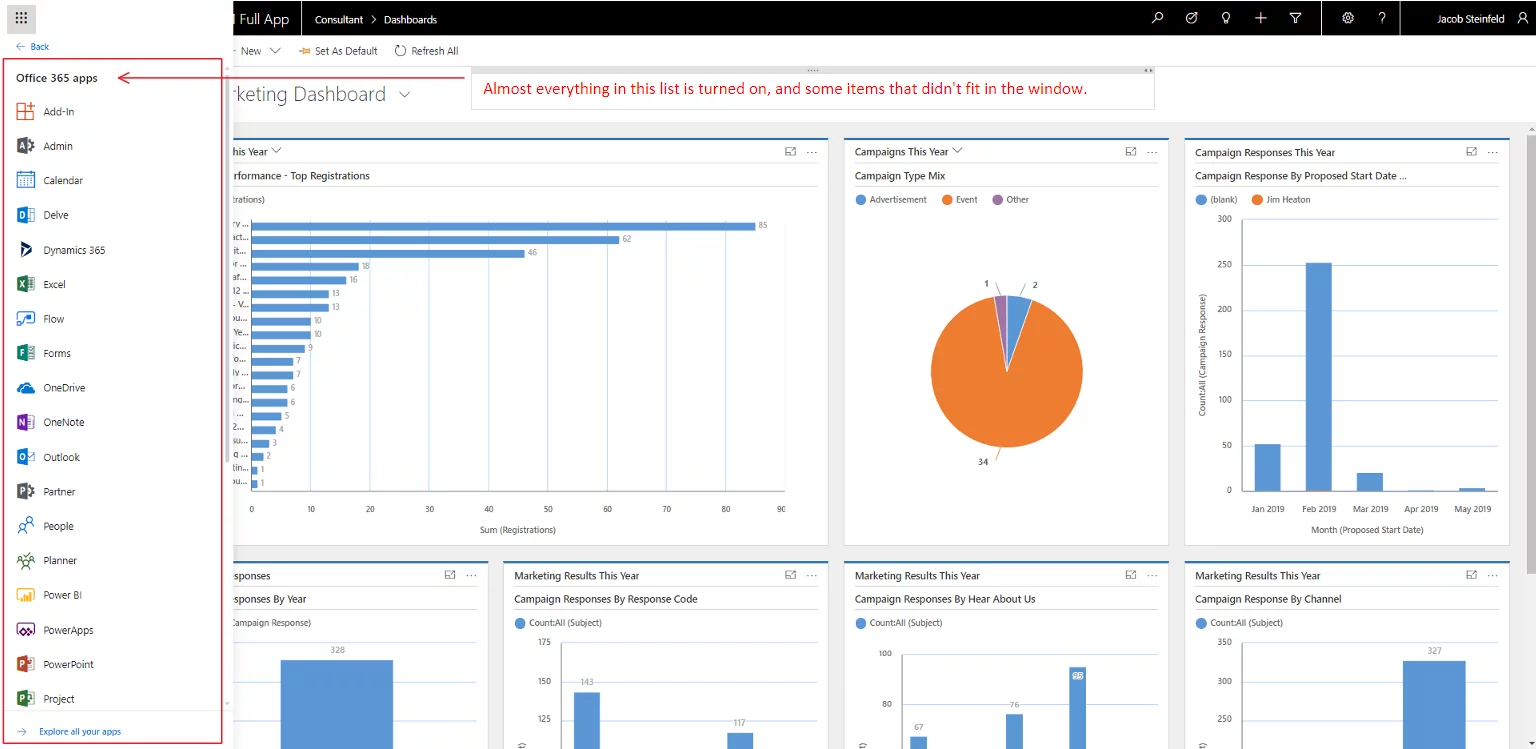
So what happens when you turn on all of Microsoft’s features for Dynamics 365 for Sales? Several 16 hour days and 100s of cups of coffee later (here’s the twist) you get the most powerful sales tool you could ever imagine. I may have lost a bit more hair implementing this system for arguably my toughest customer, my own company, but the productivity tools we implemented are outstanding. Today I edited a quote sent to me by a rep directly from Outlook, converted it to pdf and sent it back without leaving the reply window of the email message. That’s right, I didn’t have to download it, open it, make my adjustments, save to a folder, then reply and launch the file explorer and attach the new file with the new filename, then upload it to my cloud storage to meet the company’s SOP requirements. I was able to edit it right in the reply window and it auto-saved and attached the file with my initials in the file name for revision control. I hit track and everything was taken care of.
The features our sales reps now have:
- 20,000+ LinkedIn connections in CRM now and when the April ’19 release comes they’ll even have live updated org. charts.
- More leads! Our sponsored content and website registrations automatically create sales leads for my reps to follow up on.
- Live accounting data for reference; outstanding orders, sales for the year, credit balance, etc. all available on every account screen in Dynamic 365 for Sales. No additional licensing required.
- Create quotes and orders in CRM that go straight to accounting when deals are closed.
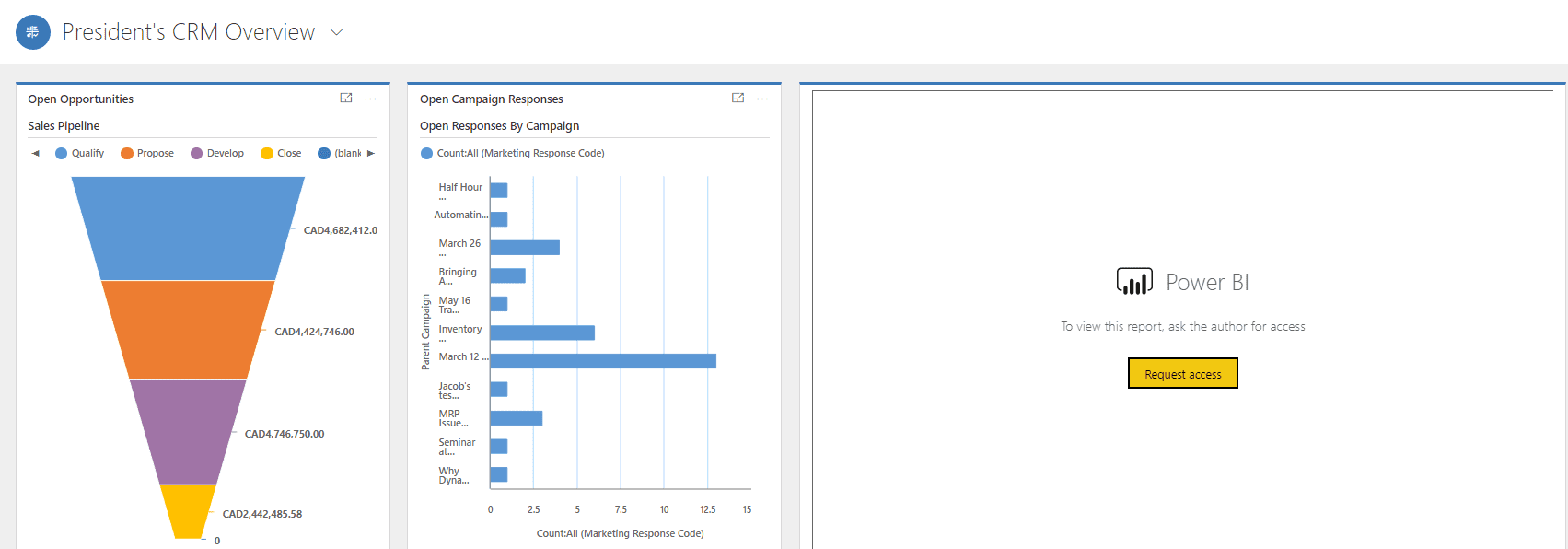
- Power BI and CRM reports side by side on the sales dashboards. Providing my team with the ability to dissect and analyze then take direct actions on their sales activities.
- Everything on this list can be accessed directly from your Outlook (on your desktop, browser, tablet, and mobile)
- An AI-powered personal assistant that provides notifications for information requests, meeting invites, upcoming deadlines, customer sentiment and priority emails that may affect open deals, and more.
- Fully automated processes that with the click of one button can generate a polished quote addressed to the customer on file, pdf’d, send it to the customer with a thank you note, an automatically scheduled follow up activity and an update to your pipeline to reflect the correct sales stage of your deal.
Again and more….
What’s the takeaway?
Let someone else go through the growing pains, and then benefit from their hard work. In this case, we did the hard part and now we’re ready to roll out the system to all of our customers. If you have any questions about my implementation experience with this project or want to know more about Microsoft’s Sales productivity tools, send me your message and I will answer all of your detailed questions. My contact details are on our company page.
Blog post by Jacob Steinfeld – Dynamics 365 Solution Architect
Jacob Steinfeld is a graduate of the Electronic Media Design program at Langara College in Vancouver, British Columbia, specializing in marketing & user interface design. For the last 3 years, Jacob has been a Dynamics 365 consultant with Vox ISM, supporting our various customers in the manufacturing, distribution, and healthcare industries. Jacob brings his sales and marketing expertise to his customers to aid in the implementation of new CRM systems.

Why Manufacturers Need a Digital Marketing Plan in 2019
Digital Marketing for Manufacturers in 2019 is going to be more important than ever. Lead generation is occurring more and more in the online space, and if manufacturers don’t invest in a digital plan now, it could mean paying massive amounts for it later. Did you know that by 2025, 75% of the workforce will be millennials who conduct most, if not all, of their business online? There’s no more time to ignore this fact. It is evident that we are in the digital age and rely on the Internet to solve all of our problems. Companies that make these solutions clearer and choices easier for us are typically the ones that win our business.
So manufacturers, have we convinced you yet? Here are three more reasons why it is imperative that manufacturers implement a digital marketing plan.
75% of people judge the credibility of a company based on the design of its website alone
You don’t want to be missing out on easy-to-get leads just because your website isn’t mobile-friendly or your design isn’t pleasing to the eye.
94% of B2B customers are doing their initial research on their own (Google)
Before a customer picks up the phone to call your business, they’re already multiple steps further along the sales cycle. Understanding SEO will help you get more qualified leads so by the time a customer calls you they will already know what they want from you and how you can help them.
Employees and customers are beginning to be younger
Businesses need to adapt their communications strategies to cross all forms of technology to connect with their employees and multigenerational buyers (MHEDA Journal). Ditch the outdated and hard-to-use business software for an up-to-date and fully integrated CRM system to help combat multigenerational differences and track where your leads are coming from.
Believe it or not, the majority of manufacturing companies are still in the early stages of content marketing. Meaning there’s still time for you to rank higher on Google and start capturing missed leads with the right marketing strategies and software to make it happen.
To learn more about these must-have marketing strategies we would like to invite you to the December 12 Vox ISM’s Exclusive Marketing webinar where Co-Founders of Waves Digital Canada will be guest speaking. For complete agenda and registration, click here.
Blog post by Marie Scholz, Co-Founder, Waves Digital Canada.

Waves Digital is a Canadian marketing agency specializing in small to medium-sized business clients. Waves Digital Canada builds thought leaders and trendsetters through cutting-edge marketing strategies and consultation.
Microsoft Dynamics 365 – A Winning CRM
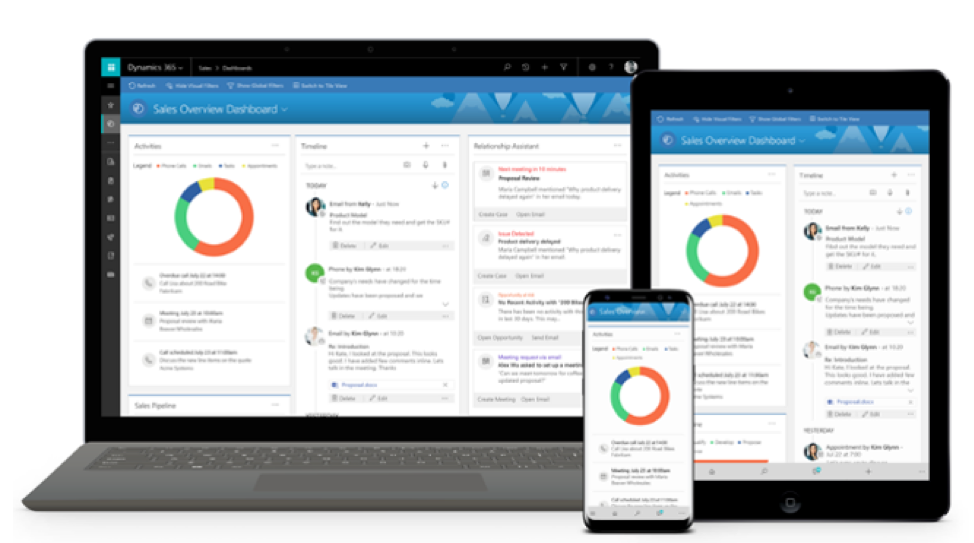
In 2017, Gartner announced that CRM had become the world’s largest software market. In 2018, it has continued to grow into a necessary investment for companies at any stage. CRM Magazine recently named the category winners in the CRM market. It was no surprise that Microsoft’s name came up numerous times. Microsoft Dynamics CRM won in both Enterprise CRM Suite and Small-Business CRM suite categories historically won by different platforms. They were also recognized as leaders in the Midmarket CRM Suite, Sales Force Automation, Sales Force Performance Management, and Business Intelligence categories.
Back in 2016, Microsoft purchased LinkedIn for $26.2 billion dollars. The reason for the purchase was to create an ecosystem for users that made it easy to transfer LinkedIn connections to CRM leads automatically. LinkedIn has since been integrated directly in Microsoft Dynamics CRM making it one of the most powerful tools in lead management. LinkedIn along with the evolution of Microsoft AI that has been weaved throughout their software makes Microsoft an attractive software.
If you’d like to see Microsoft Dynamics CRM for yourself, feel free to attend one of our free events here.
Blog Post by Jeff Vandenberg – Sales Team Member
Jeff Vandenberg graduated with a B.Comm from Seneca College with a major in Enterprise Resource Planning (ERP).
Jeff currently works as part of the Conversion Team for Vox ISM to help bring customers to a solution that fits their needs. Jeff’s years of experience in the service industry can provide value to companies that are looking for ways to constantly improve.